

What Is a Dismissal Protection Claim?
A dismissal protection claim (Kündigungsschutzklage) is the legal procedure through which employees can ask a German Labour Court to review whether a dismissal is valid.
The primary purpose of the claim is to obtain a judicial declaration that the employment relationship has not been terminated by the specific dismissal in question.
A severance payment is generally not the direct legal objective of a dismissal protection claim. In practice, however, many proceedings end with a settlement under which the parties agree to terminate the employment relationship in return for a severance payment.
The Crucial Deadline: Three Weeks
How the Deadline Is Calculated
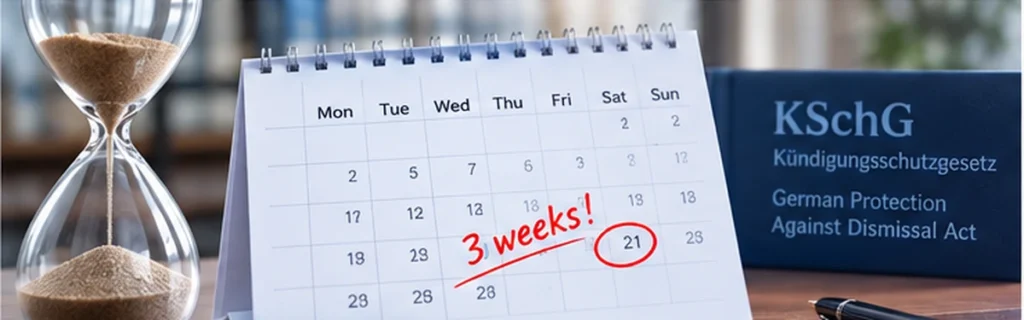
The three-week period does not begin on the actual day on which the employee receives the notice of dismissal. Although receipt of the notice triggers the deadline, the day of receipt itself is not included in the calculation.
The period therefore begins on the following day and normally ends three weeks later at the end of the day corresponding by name to the day on which the dismissal was received.
Saturdays, Sundays and public holidays are generally included when calculating the three-week period. However, where the final day falls on a Saturday, Sunday or statutory public holiday, the deadline is extended until the end of the next working day.
Consequences of Missing the Deadline
Where an employee does not challenge the dismissal before the Labour Court within three weeks of receiving it, the dismissal is generally deemed to have been legally valid from the outset pursuant to section 7 of the German Protection Against Dismissal Act (Kündigungsschutzgesetz – KSchG).
A claim filed at a later date will therefore normally be unsuccessful, even where there were originally serious doubts about the validity of the dismissal.
A late claim may only be admitted in exceptional circumstances where the employee was prevented from filing the claim in time despite exercising all reasonable care that could be expected under the circumstances.
The application for retrospective admission must generally be submitted within two weeks after the obstacle has ceased to exist. Once six months have passed since the end of the original deadline, retrospective admission is generally no longer possible.
Requirements for Protection Against Dismissal
When Does General Protection Against Dismissal Apply?
General protection under the German Protection Against Dismissal Act normally applies where:
- the employment relationship had existed for more than six months when the dismissal was received; and
- the establishment regularly employs more than ten employees.
Part-time employees are counted proportionately when determining the size of the establishment:
- employees regularly working no more than 20 hours per week are counted as 0.5;
- employees regularly working no more than 30 hours per week are counted as 0.75; and
- employees working more than 30 hours per week are counted as 1.0.
Apprentices and other vocational trainees are not included in this calculation. Special transitional provisions may apply to employment relationships that already existed before 1 January 2004.
Even where general protection against dismissal does not apply because the establishment is too small or the six-month qualifying period has not yet been completed, a dismissal may still be invalid for other reasons.
Possible grounds of invalidity include:
- failure to comply with the statutory written-form requirement;
- special statutory protection against dismissal;
- a violation of the prohibition against retaliatory measures;
- failure to observe the participation rights of a works council; or
- a violation of other mandatory legal provisions.
Employees working in a small business or during the first six months of employment should therefore also have a written dismissal reviewed within the three-week period.
Types of Dismissal and Their Particular Requirements
Dismissal for Operational Reasons
In the case of a dismissal for operational reasons (betriebsbedingte Kündigung), the employer must demonstrate urgent operational requirements that result in the permanent elimination of the employee’s position or the need for their work.
There must also be no reasonable possibility of continuing to employ the employee in another vacant position within the establishment or company.
Where several comparable employees could be affected, the employer must generally carry out a proper social selection process. The following factors must be taken into account in particular:
- length of service;
- age;
- maintenance obligations; and
- severe disability.
Conduct-Related Dismissal
A conduct-related dismissal (verhaltensbedingte Kündigung) normally requires a culpable breach of the employee’s contractual duties.
As a rule, the employer must previously have issued the employee with a valid warning concerning comparable misconduct.
A prior warning may exceptionally be unnecessary where:
- it is already apparent that the employee will not change their conduct; or
- the breach of duty is so serious that the employee could not reasonably have expected the employer to tolerate it.
Person-Related and Illness-Related Dismissal
A person-related dismissal (personenbedingte Kündigung) may be considered where the employee is expected to be unable to perform the contractually required work, either completely or to the required extent, for reasons relating to their personal circumstances.
The employee does not need to be at fault.
A dismissal issued while an employee is unfit for work is not invalid merely because the employee is on sick leave. However, where the dismissal is specifically based on illness-related absences, the Labour Court generally applies a three-stage test:
- There must be a negative health prognosis.
- The expected future absences must result in significant operational or financial disruption.
- A final balancing of interests must show that the employer can no longer reasonably be expected to continue the employment relationship.
The employer must also consider whether less severe measures are available. These may include adapting the workplace or transferring the employee to another suitable position.
Failure to conduct a workplace integration management procedure (betriebliches Eingliederungsmanagement – BEM) does not automatically make a dismissal invalid. It can, however, considerably increase the employer’s burden of demonstrating that no less severe alternative to dismissal was available.
Summary Dismissal Without Notice
An extraordinary dismissal without notice (außerordentliche fristlose Kündigung) requires good cause within the meaning of section 626(1) of the German Civil Code (Bürgerliches Gesetzbuch – BGB).
There must be facts which, taking into account all circumstances of the individual case and weighing the interests of both parties, make it unreasonable to expect the dismissing party to continue the employment relationship until the expiry of the ordinary notice period.
In addition, an extraordinary dismissal must generally be declared within two weeks after the person authorised to issue the dismissal becomes aware of the relevant facts.
Employees must also comply with the three-week deadline when challenging a summary dismissal without notice.
Dismissal During a Probationary Period
Where a probationary period has been expressly agreed, the employment relationship may be terminated with two weeks’ notice pursuant to section 622(3) BGB.
This statutory rule applies for a maximum of the first six months of the employment relationship. Collective bargaining agreements or contractual provisions that are more favourable to the employee may provide otherwise.
The probationary period and the six-month qualifying period under the German Protection Against Dismissal Act are legally distinct.
General protection against dismissal normally applies after more than six months of employment, regardless of whether the contract provides for a shorter or longer probationary period or no probationary period at all.
Special statutory protection against dismissal may apply even before the six-month qualifying period has been completed.
Procedure Before the German Labour Court
Filing the Claim
The dismissal protection claim must be received by the competent Labour Court within the three-week period.
The standard application requests the Court to declare that the employment relationship was not terminated by the specifically identified dismissal.
The statement of claim must make clear:
- who the parties are;
- which court is being addressed;
- which dismissal is being challenged; and
- what specific judicial decision is being requested.
A comprehensive legal justification does not necessarily have to be submitted together with the initial claim filed to preserve the deadline. However, the dismissal and the underlying facts must be identifiable with sufficient clarity.
There is no legal requirement to be represented by a lawyer in first-instance proceedings before the Labour Court.
Nevertheless, early advice from a specialist employment lawyer is generally advisable because of the short deadlines, the rules regarding the burden of presentation and proof, and the potential financial consequences.
Conciliation Hearing
After receiving the claim, the Labour Court will normally first schedule a conciliation hearing (Gütetermin).
This hearing is conducted before the presiding judge of the competent chamber. Its primary purpose is to explore whether the parties can reach an amicable settlement.
Where a duly summoned party fails to attend, serious procedural disadvantages may arise, including the possibility of a default judgment.
Many dismissal protection proceedings are concluded through a court settlement either during the conciliation hearing or at a later stage.

Full Chamber Hearing and Taking of Evidence
Where no settlement is reached, the proceedings continue to a full chamber hearing (Kammertermin).
The Court may examine and evaluate evidence, including:
- witness testimony;
- documents;
- expert opinions; and
- other admissible evidence.
Both parties may submit applications and present their arguments.
Judgment and Appeal
A judgment of the Labour Court may be appealed to the Regional Labour Court (Landesarbeitsgericht) under the conditions set out in section 64 of the German Labour Courts Act (Arbeitsgerichtsgesetz – ArbGG).
In disputes concerning the existence, non-existence or termination of an employment relationship, an appeal is admissible irrespective of whether the value of the subject matter of the appeal exceeds EUR 600.
The deadline for filing an appeal is generally one month from service of the fully reasoned judgment.
Legal representation is mandatory in appeal proceedings before the Regional Labour Court.
Costs of a Dismissal Protection Claim

Court Costs
The value in dispute relevant to court costs and statutory legal fees is determined by the Labour Court.
For a dismissal protection claim, the value in dispute is generally limited to a maximum of three months’ gross remuneration.
Additional claims, such as claims for outstanding salary, may increase the total value in dispute.
Court fees are generally incurred where the proceedings end with a contested judgment. Where the entire dispute is concluded by a court settlement, no court fees are generally charged.
However, additional court expenses may remain payable, for example expenses relating to:
- witnesses;
- expert witnesses;
- interpreters; or
- translations.
Lawyers’ Fees
In first-instance judgment proceedings before a German Labour Court, each party generally bears its own lawyers’ fees, regardless of whether it wins or loses the case.
An employee who succeeds in the proceedings will therefore normally not be entitled to reimbursement of their lawyers’ fees by the employer.
Different cost-reimbursement rules apply from the appeal stage onwards. The unsuccessful party may then also be required to reimburse the opposing party’s statutory lawyers’ fees.
Costs Where Legal Expenses Insurance Exists
Depending on the insurance contract and the scope of the insurer’s confirmation of cover, employment-law legal expenses insurance may cover:
- statutory lawyers’ fees;
- court costs; and
- additional procedural expenses.
Any agreed insurance excess or deductible will generally remain payable by the policyholder.
A request for confirmation of cover should be submitted without delay. However, because of the three-week deadline, the filing of the claim must not be made dependent on whether the insurer has already confirmed cover.
Costs Without Legal Expenses Insurance
Without legal expenses insurance, each party generally bears its own lawyers’ fees in first-instance proceedings.
Where the employee loses the case, additional court costs may be incurred. However, the employee will generally not be required to reimburse the employer’s lawyers’ fees in the first instance.
Employees with limited financial means may apply for legal aid (Prozesskostenhilfe).
The granting of legal aid depends in particular on:
- the employee’s personal and financial circumstances; and
- whether the proposed legal action has sufficient prospects of success.
Severance Payments and Settlements
When Is a Severance Payment Possible?
There is no general statutory entitlement to a severance payment following a dismissal under German law.
A statutory entitlement or a severance payment awarded by a court is only available in specific circumstances, for example:
- following a valid severance offer under section 1a KSchG;
- following a judicial dissolution of the employment relationship under sections 9 and 10 KSchG; or
- under a social compensation plan.
In practice, severance payments are predominantly agreed as part of an out-of-court or court settlement.
As a non-binding point of reference, negotiations frequently begin with an amount equal to half of one gross monthly salary for each year of employment.
The severance payment that can actually be achieved may be considerably higher or lower depending on factors such as:
- the litigation risk;
- the grounds for dismissal;
- the employee’s length of service;
- the employee’s remuneration; and
- the parties’ respective negotiating positions.
Settlement in Dismissal Protection Proceedings
In addition to a severance payment, a settlement may contain provisions concerning:
- the termination date;
- release from the duty to work;
- outstanding holiday entitlement;
- bonus claims;
- an employment reference;
- the return of company property; and
- the final calculation and settlement of the employment relationship.
A court settlement may be recorded during a hearing or formally established in written proceedings by a court order pursuant to section 278(6) of the German Code of Civil Procedure (Zivilprozessordnung – ZPO).
An out-of-court settlement is also possible. Where court proceedings have already been initiated, additional procedural declarations will then be required to bring those proceedings to an end.
Continued Employment and Remuneration for Default of Acceptance
Where an employer’s dismissal is found to be invalid, the employee may generally claim remuneration for the period during which the employer failed to accept their work. This is referred to under German law as remuneration for default of acceptance (Annahmeverzugslohn).
A claim generally requires the employee to have been both able and willing to work during the relevant period.
Income earned from alternative employment may be deducted from the claim. In certain circumstances, income that the employee maliciously failed to earn may also be taken into account.
Prospects of Success and Common Mistakes
Common Mistakes to Avoid
- Missing the deadline: Failing to observe the three-week period.
- Incomplete claim: Failing to identify the dismissal correctly or submitting an incorrect application.
- Insufficient evidence: Failing to preserve warnings, medical certificates, correspondence or information about potential witnesses.
- Overestimating the severance payment: Entering negotiations with unrealistic expectations.
Realistic Assessment of the Prospects of Success
The prospects of success of a dismissal protection claim depend heavily on the circumstances of the individual case.
Relevant factors include:
- the type of dismissal;
- the available evidence;
- the size of the establishment;
- the employer’s social selection process; and
- compliance with statutory and procedural requirements.
A reliable assessment cannot be made in the abstract. An experienced specialist employment lawyer can provide a substantiated evaluation after reviewing the relevant documents and facts.
Checklist: What to Do After Receiving a Dismissal

Document Receipt
Record the date and circumstances under which the notice of dismissal was received. Keep the envelope in which the notice was delivered.
Check the Written-Form Requirement
Determine whether you received an original document bearing a handwritten signature.
A dismissal sent by email, WhatsApp or as a scanned document generally does not comply with the written-form requirement under section 623 BGB.
Record the Three-Week Deadline
The dismissal protection claim must generally be received by the Labour Court no later than three weeks after the employee receives the written dismissal.
Check the Notice Period
Review the employment contract, any applicable collective bargaining agreement and the statutory notice periods.
Preserve Relevant Documents
Collect and preserve the following documents in particular:
- the employment contract;
- the notice of dismissal;
- written warnings;
- payslips;
- emails and other correspondence;
- target agreements; and
- any other relevant evidence.
Check for Special Protection Against Dismissal
Determine whether special statutory protection may apply, particularly in cases involving:
- pregnancy;
- parental leave;
- severe disability;
- works council membership; or
- family care leave.
Review Works Council Involvement and Social Selection
Determine whether a works council exists and whether it was properly consulted before the dismissal.
In the case of a dismissal for operational reasons, review whether comparable employees exist and whether the employer carried out a proper social selection process.
Inform Your Legal Expenses Insurer
Submit a request for confirmation of insurance cover without delay. Do not allow the request for cover to jeopardise the deadline for filing the claim.
Obtain Legal Advice
Have the following matters reviewed at an early stage:
- the prospects of continued employment;
- a possible severance payment;
- release from the duty to work;
- the wording of an employment reference;
- outstanding remuneration; and
- other potential claims arising from the employment relationship.
Conclusion
A dismissal protection claim is the central legal instrument for challenging an unlawful termination of employment in Germany.
Compliance with the three-week deadline is the most critical requirement. The conciliation hearing before the Labour Court provides a realistic opportunity to reach a settlement, frequently involving a severance payment and arrangements concerning continued employment, release from work or remuneration for default of acceptance.
The financial risk is often manageable, particularly where legal expenses insurance is available. Without insurance, there is a cost risk, although this may be reduced through legal aid where the statutory requirements are met.
Ultimately, the prospects of success depend on the specific circumstances, including the type of dismissal, the evidence available and the employer’s social selection process.
Obtaining legal advice at an early stage can significantly improve the chances of achieving a favourable result.
Employment Law Advice for Employees
Have you received a notice of dismissal in Germany?
A dismissal protection claim must normally be filed with the German Labour Court within three weeks of receiving the written notice of dismissal.
Adrian Jäckel, Attorney at Law and Certified Specialist in Employment Law, advises and represents employees throughout Germany in English, German and Spanish.
Request employment law advice in English
This article provides general information and does not constitute legal advice for any individual case.
Frequently Asked Questions
How Much Time Do I Have to File a Dismissal Protection Claim?
The claim must be received by the competent Labour Court within three weeks after the employee receives the written notice of dismissal.
Do I Need a Lawyer for a Dismissal Protection Claim?
There is no mandatory legal representation in first-instance proceedings before the Labour Court.
However, because of the short filing deadline, procedural requirements and potential financial consequences, advice and representation by a specialist employment lawyer is generally advisable.
Who Pays the Costs of a Dismissal Protection Claim?
In first-instance proceedings before a German Labour Court, each party generally bears its own lawyers’ fees, regardless of the outcome of the case.
Where the Court issues a contested judgment, court costs are generally imposed on the unsuccessful party.
Where the entire proceedings are concluded by a court settlement, no court fees are generally charged. Additional court expenses may nevertheless remain payable.
Depending on the insurance contract and the confirmation of cover, legal expenses insurance may cover the costs of the proceedings.
Is There a Statutory Entitlement to a Severance Payment Following a Dismissal?
A statutory entitlement to a severance payment exists only in exceptional circumstances, for example under a social compensation plan or following a valid offer under section 1a KSchG.
In practice, severance payments are usually negotiated as part of an out-of-court or court settlement in dismissal protection proceedings.